
Staff Shortages in Air Cargo at Schiphol: 7 Practical Solutions for Employers

Staff Shortages in Air Cargo at Schiphol: 7 Practical Solutions for Employers
A staff shortage in air cargo at Schiphol can have a major impact on day-to-day logistics operations. Goods need to be received, inspected, stored and prepared for transport on time. When there are not enough employees available, the pressure on existing teams increases and delays can occur.
For employers in the air cargo sector, it is therefore important to respond in good time to changes in staffing needs.
But how can you reduce staff shortages without compromising safety, quality or efficiency?
In this article, we discuss seven practical solutions that help air cargo companies in and around Schiphol organise their staffing more effectively.
Why do staff shortages occur in the air cargo sector?
The air cargo sector faces specific challenges when it comes to staffing and planning.
Unlike many other logistics environments, air cargo operations depend heavily on aircraft arrival and departure times. As a result, workload can vary considerably throughout the day.
Several other factors also play a role:
- Fluctuating cargo volumes and peak periods.
- Irregular working hours and shift work.
- The need for employees with specific skills.
- Security procedures and access requirements.
- Sickness absence and unexpected absences.
- Competition for experienced logistics employees.
Not every position requires the same experience or certificates. Even so, employers must take into account the tasks, responsibilities and any safety requirements of each role.
Moreover, a staff shortage does not always arise because there are too few employees. Sometimes the available staffing simply does not match the moments when the work needs to be done.
1. Analyse when staff shortages occur
The first step is to gain insight into the moments when your organisation actually needs extra staff.
For example, look at how many employees are available during different shifts and compare this with the amount of work.
Pay attention to:
- Busy arrival and departure times.
- Differences between day, evening and night shifts.
- Seasonal changes in cargo volumes.
- Recurring periods of sickness absence.
- Tasks that require specific experience.
By analysing this information regularly, you can better determine where the biggest bottlenecks arise.
Practical tip: Over a period of several weeks, compare the planned staffing with the hours actually worked and the amount of cargo processed. This makes recurring problems visible more quickly.
2. Make your workforce planning more flexible
A fixed staffing level is not always sufficient to absorb fluctuating cargo volumes.
It is therefore wise to align your workforce planning with the expected workload.
Flexible planning can, for example, consist of a combination of permanent employees and additional employees for busy periods.
Take the following into account:
- The expected volume of inbound and outbound cargo.
- The number of employees required per shift.
- The skills and authorisations of employees.
- Available replacements in case of unexpected absence.
- Statutory working and rest times.
Flexibility does not mean that employees have to constantly switch shifts. Clear agreements and predictable schedules remain important.
You can read more about this in our article on workforce planning in logistics.
3. Deploy employees based on their skills
Not every employee can automatically perform all tasks within an air cargo warehouse.
Some roles require experience with warehouse processes, internal transport or air cargo handling. Other tasks may be subject to specific training, certificates or access requirements.
Therefore, map out which skills are available within your team.
Think of:
- Receiving and registering goods.
- Loading and unloading.
- Sorting and order processing.
- Forklift and reach truck operation.
- Building and breaking down air cargo pallets.
- Checking cargo data and documents.
When employees are deployed on the right tasks, this can contribute to a more efficient distribution of work.
An overview of skills and authorisations also helps you arrange replacements more quickly.
4. Start looking for extra air cargo staff in good time
Many companies only start looking for employees when the workload has already increased.
This can cause problems, especially when positions require specific experience or additional checks.
By starting recruitment earlier, you create more room to find suitable candidates and assess them carefully.
Determine in advance:
- Which tasks need to be performed.
- How many employees are needed.
- Which experience is important.
- Which working hours and shifts apply.
- Which certificates or safety requirements apply.
- When employees are available
More articles
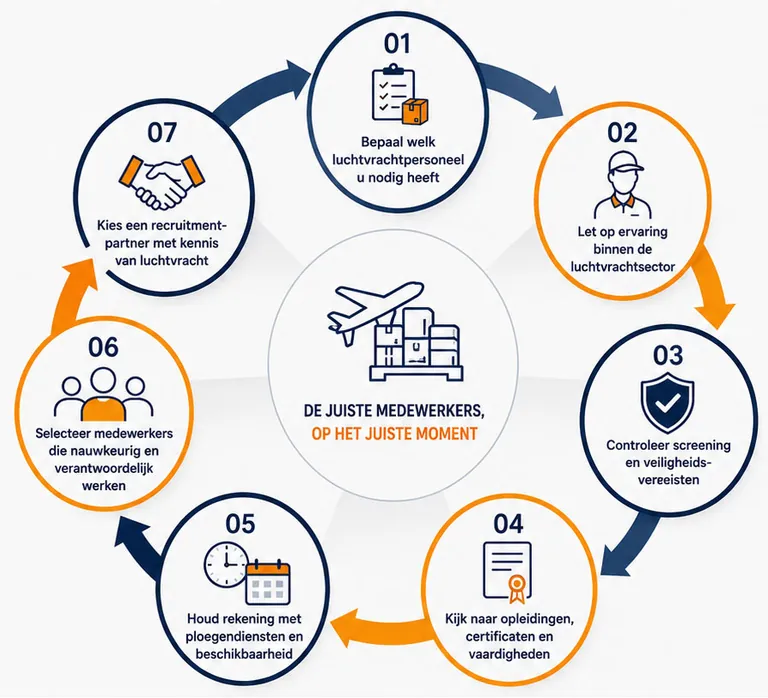
Finding Air Cargo Staff: 7 Tips for Employers
Looking for air cargo staff for your business? Discover 7 tips on experience, screening, certifications, and the availability of suitable employees.

Logistics Staff Planning: 7 Tips for Employers
Improve logistics staff planning? Discover 7 practical tips to prepare your warehouse for peak periods and plan your staffing needs in advance.

Hiring Order Pickers: How to Find the Right Warehouse Staff
Hiring order pickers for your warehouse or distribution center? Discover what to pay attention to regarding experience, safety, availability, and costs.