
The future of work in Dutch logistics
What technological changes mean for workers and skills
The future of logistics jobs in the Netherlands
An important but often underestimated effect of automation is that new roles emerge.
How AI and automation are changing work for employees and employers towards 2026
The logistics sector in the Netherlands is changing rapidly. Automation and Artificial Intelligence (AI) are no longer experiments but established parts of daily work in warehouses, distribution centers, and transport planning.
This raises the same question for many people:
Will AI and automation replace logistics jobs?
The short answer is: no.
The realistic answer is that logistics work in 2026 will be organized differentlythan it is today.
Why automation and AI are becoming increasingly important in logistics
The Netherlands plays a key role in European logistics. With major ports, airports, and e-commerce hubs, the focus is strongly on speed, reliability, and efficiency.
The growth of automation is mainly driven by:
- Structural staff shortages in logistics and warehousing
- Growing e-commerce and shorter delivery times
- Pressure to reduce errors, costs, and waste
- Sustainability goals and more efficient transport
Automation helps companies organize processes more intelligently, not to replace people on a large scale.
Which AI and automation technologies are already being used?
Many logistics employees already work today with technology that is partly driven by AI, often without it being explicitly labeled as such.
Common applications include:
- Automated picking and sorting systems
- Warehouse Management Systems (WMS) with AI support
- Smart scanners and quality controls
- Predictive inventory and demand planning
- Route optimization for transport and planning
These systems support employees in their work and provide greater oversight, safety, and accuracy.
Which logistics roles are changing the most?
Roles with many repetitive tasks are especially changing due to automation. This does not mean these jobs disappear, but rather that the content of the work shifts.
- Warehouse worker: Change driven by AI: Less manual work, more system support
- Order picker: Change driven by AI: Working faster and more accurately
- Forklift driver: Change driven by AI: Partial automation with supervision
- Inventory planner: Change driven by AI: More data analysis, less manual counting
- Logistics coordinator: Change driven by AI: More insight, less ad hoc planning
AI mainly takes over repetitive tasks, allowing employees to focus on control, safety, and problem-solving.
New logistics roles through automation
In modern logistics environments, demand is growing for:
- Automation Supervisors
- Warehouse system operators
- Maintenance technicians for automated installations
- Logistics data analysts
- Process improvement specialists
These are roles that barely existed a few years ago and will become increasingly common in 2026.
Which skills will become important in 2026?
For employees, the good news is that most logistics roles do not require IT or programming knowledge.
What does become important is the willingness to work together with technology.
Technical skills
- Working with digital systems
- Understanding automated processes
- Basic knowledge of dashboards and data
Human skills
- Problem-solving ability
- Workplace communication
- Safety awareness
- Flexibility and willingness to learn
Employees who adapt to new ways of working remain attractive to employers.
What does this mean for employers in the Netherlands?
For employers, automation mainly changes the way recruitment and training are approached.
Key points of attention looking toward 2026 are:
- Finding candidates who are comfortable with technology
- Reskilling existing staff instead of replacing them
- Clear and realistic job profiles
- Supporting teams through change
Companies that invest in both people and technology build more sustainable teams and experience lower turnover.
Will AI and automation replace logistics jobs?
No.
AI does not replace people, but inefficient processes.
Even in 2026, there will still be strong demand in the Netherlands for warehouse workers, planners, drivers, supervisors, and coordinators. What changes is how these roles are carried out and the skills they require.
Who adapts stays employable.
Who invests in their people remains competitive.
The role of recruitment in a changing logistics sector
As logistics roles evolve, recruitment is becoming increasingly important. It is no longer just about filling vacancies, but about finding the right match between people, roles, and the working environment.
Effective recruitment requires insight into modern logistics as well as an understanding of the people working within it.
Conclusion
AI and automation do not pose a threat to logistics jobs in the Netherlands. They are transforming the sector, while also making it more future-proof.
In 2026, the most successful logistics professionals will be those who see technology as support, not as competition.
And the strongest logistics organisations will remain those where people are at the centre.
Would you like to know what this means for your career or for recruitment and selection in logistics? Get in touch with NFA Recruitment.
Latest vacancies
More articles

Staff Shortages in Air Cargo at Schiphol: 7 Practical Solutions for Employers
Staff shortages in air cargo at Schiphol can lead to delays and extra pressure on teams. Discover 7 practical solutions for employers to improve their workforce planning, find suitable employees and organise air cargo operations efficiently.
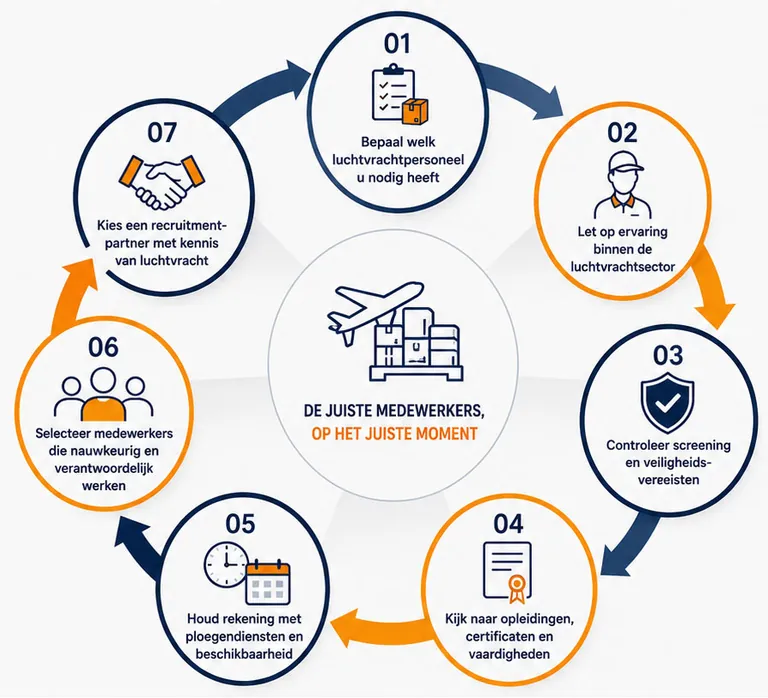
Finding Air Cargo Staff: 7 Tips for Employers
Looking for air cargo staff for your business? Discover 7 tips on experience, screening, certifications, and the availability of suitable employees.

Logistics Staff Planning: 7 Tips for Employers
Improve logistics staff planning? Discover 7 practical tips to prepare your warehouse for peak periods and plan your staffing needs in advance.